"Why Does My Canary Bird Have
Scaly Feet and Legs?"
There are two common reasons for your pet canary
to have scaly feet and legs...
MIDDLE-AGE and MITES
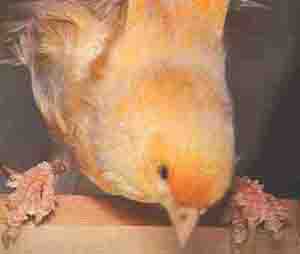
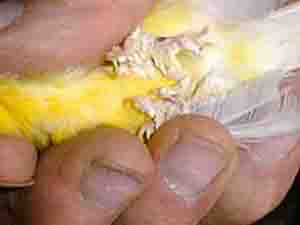
NATURAL CALCIFICATION: In older birds, scaly legs are slowly--and quite naturally--caused by a build-up of calcium salt between the scales of your canary’s feet and legs. Even in an otherwise healthy bird your canary's legs will appear dry and flaky.
MITES: Scaly legs in canaries are often caused by an infestation of scaly leg mites (Knemidokoptes spp.). These microscopic parasites burrow under the scales of the bird's legs and feet, causing irritation, inflammation, and the formation of crusty, raised scales.
FREE Email Course.
Sign up below and get the 5 part email course: "The #1 Problem You Will Face As A Canary Owner"
Scaly Feet on Older Canaries
Older canaries commonly have a heavy build-up of scales and the amount of scales is sometimes used to determine the age canaries.
As Dr. Rob Marshall states in Canary Health, the “legs of young birds are cleaner than old birds and quite free of scale”.
Some canaries, though, are susceptible to having the calcium salt problem their whole life.
The aging process is not the only reason for these scales. Scaly feet could also be an indication of a...
Mite Infestation
These Scaly Mites live in, and feed on, the scales of your canary’s feet and legs. In severe cases these mites will move up to the beak area of the face.
If your canary bird is relatively young and has scaly feet and legs, it is safe to assume you have a mite problem...or at least your canary does ;)
Additionally, poor husbandry practices, such as dirty living conditions or overcrowded cages, can contribute to the spread of mites and exacerbate the condition.
Other factors, such as nutritional deficiencies or underlying health issues, may also weaken the bird's immune system, making them more susceptible to mite infestations. Regular monitoring and proper hygiene are essential for preventing and managing scaly leg mites in canaries.
Treating for the Scaly Feet Mite
Treating scaly leg mites in pet birds involves several steps to effectively eliminate the infestation and alleviate discomfort for the bird:
- Isolation: Quarantine the affected bird to prevent the spread of mites to other birds.
- Cleaning: Thoroughly clean the bird's cage and surrounding area to remove any mites or debris.
- Topical Treatment: Apply a veterinary-prescribed topical treatment directly to the affected areas on the bird's legs. Common treatments include products containing ivermectin or permethrin, which effectively kill mites.
- Softening Agents: Use softening agents such as olive oil or petroleum jelly to gently soften the scales on the bird's legs, making it easier to remove dead mites and damaged tissue.
- Soaking Baths: Soak the bird's legs in warm water mixed with mild soap to help soften scales and facilitate the removal of the build up. Be gentle during this process to avoid causing further discomfort to the bird.
- Repeat Treatments: Follow the veterinarian's instructions for repeat treatments as needed to ensure complete eradication of mites. Treatment may need to be administered over several weeks to fully eliminate the infestation.
- Environmental Treatment: Treat the bird's cage and surrounding environment with a bird-safe disinfectant to kill any mites that may be present.
- Monitor for Improvement: Monitor the bird's legs regularly for signs of improvement, such as reduced swelling and redness, and continue treatment until the condition has resolved completely.
It's important to consult with a veterinarian experienced in avian care for proper diagnosis and treatment of scaly leg mites. They can provide personalized treatment recommendations and guidance to ensure the bird's health and well-being.
A heavy accumulation of this scaling may cause irritation to your bird and may even result in difficulty walking.
This is definitely not a comfortable situation and of course can lead to overall ill health and a lack of singing.
But while this "scaliness" CAN cause problems, it’s also can be one of the natural symptoms of aging.
Ivermectin based ointments have shown to be effective but depending on your part of the world, you may have to talk to a veterinarian for access.
SCATT is an important part of canary care and an effective treatment for Scaly Mites and any other parasite that feeds on your bird’s blood.
Scatt is extremely effective on mites that feed directly on a birds blood such as Red Mites and Air Sac Mites. Although, not as effective on Scaly Mites, it has been shown to be somewhat helpful.
Scatt has a residual effect and one dose is effective for about 3 weeks. This residual effect is great because Scatt is not effective on mite eggs but as the young mites hatch out and start feeding on your canary bird they will ingest the SCATT that is remaining in your canary’s system and soon die.

Another effective treatment is MITE AND LICE SPRAY.
Some scaly feet mites like to hide in the cracks and crevices of your bird’s cage. If you haven’t treated for mites lately you should spray the cage once per week for 4 weeks with this mite and lice spray.
Mite and Lice Spray AND Skin and Feather Spray


The mites that come into contact with the spray will die but the spray has no effect on mite eggs. Therefore, you'll spray once per week so that you can kill the mites that have hatched out since the last spraying.
After 4 to 6 weeks of using Scatt on your canary, and mite and lice spray on the cage, you will have effectively eradicated the pest.
For more on mites see Canary Diseases.
Remove the Scales from the Feet and Legs
If the scales are caused by a mite problem it will take some time for the excess scaling to subside. But, as I’ve stated in the FREE CanaryTips! Ezine, regardless of what is causing them, you can get rid of the scales.
Some common methods include applying vasoline or olive oil to the scaly legs, allowing the scales to become soft, and then gently removing them.
Many breeders use the following formula...
*Wash your canary’s feet gently in warm water.
*Mix together 2 Tbs Vaseline and 1 Tbs Campho Phenique and keep in an air tight container. An alternative salve is baby oil, or you can use Vaseline exclusively, but the Campho Phenique will add some healing power to the process.
*Very gently apply this mixture on your bird’s feet and legs every day for 5 or 6 days.
*On about the 6th day the scales will begin to loosen their grip.
*If necessary rub the scales off GENTLY. A wash cloth may help to pull the scales away but if they don’t come off easily, let them be. If the scales are pulled off before they’re ready, you can cause bleeding.
Within a week your canary bird will be foot loose and scale free!
...and that's SMART canary care.
As an alternative to making up this recipe, you can us a product called VetRx. Just follow the directions on the bottle.



Return from Scaly Feet to the Canary Disease Main Page.
Have A Great Story or Tip About This Topic?
Do you have a great story or tip about canary health care? Share it! It may be of great interest and assistance to other canary owners.


